
 |
  |
Fully Paginated Editing and Navigation is now supported by the latest Sense release.
And Great News about Licensing.

RSS Document Structure
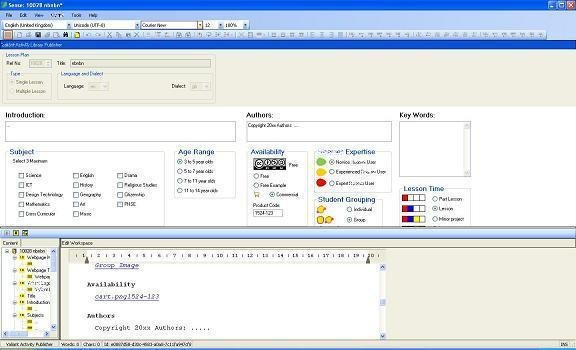
Lesson Plan Editor Plugin
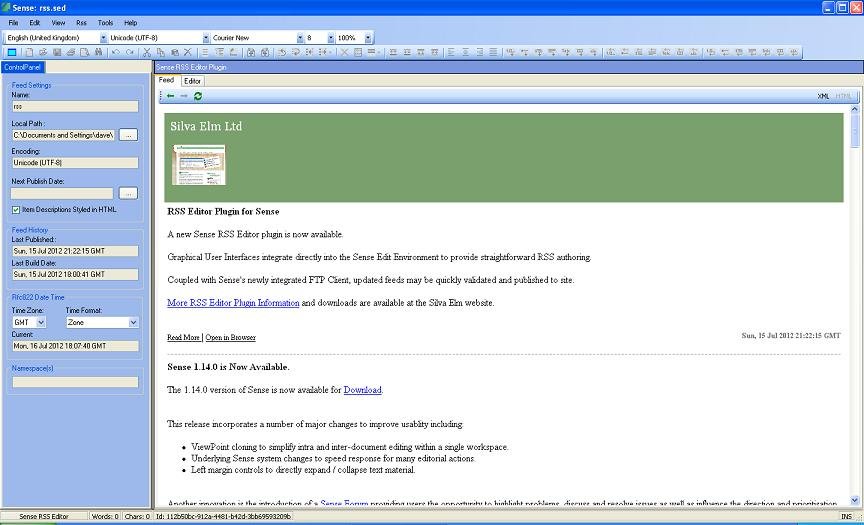
RSS Editor Plugin

RSS Editor showing Mini-Editor
Solutions
Sense has an object-oriented (rich text) editor as its core capability: document storage is in Silva Elm's XML file format.
Document editing is based on object handling where objects are simply well-recognized parts such as paragraphs and section headings. Each object is associated with a style whether document wide or specific.
The Document Structure (layout) relates to how these individual objects are grouped within the document hierarchy: sections, bullets, numbered paragraphs accomodate truly hierarchical constructs within Sense.
Sense documents may assume different structural arrangements:
- Informal as for a one off casual (rich-text) document.
- Formal according to a pre-defined document layout for, as example, a legal document or scholarly text. Typically, a document template would be available.
- Very Formal where layout is well defined and possibly embracing rigidly defined line content as may be needed, for example, in a markup language (XML, HTML) file. A document template would be mandatory in this context for easy replication.
- Mixed Formal where parts of the document comprise Formal / Very Formal layout intermixed with Informal.
Every object within Sense is allocated a Unique Identifier. This is to enable straightforward retrieval, update and replication of material.
Consequently, a Sense Document with a top level "Formal" structure may be handled as a de facto database. "Informal" content may reside beyond the formal hierarchy.
Plugins use this de facto database role to realize specific processing needs.
Utilization of Sense as a de facto database may prove a less costly solution than one based on a conventional database-oriented solution.
Case Studies
The development of Sense tools and Import/Export/Editor plugins has demonstrated the de facto database paradigm.
Continuing developments are focussing on Editor Plugins that provide task specific graphical user interfaces to integrate directly into Sense's Edit Environment.
These GUIs' will normally include one or more Editor panes providing purpose specific controls as a more practical alternative to "raw" document editing.
Developments include:
- Sense RSS Editor Plugin to author RSS XML Feeds.
- School Lesson Plan (OEM) Plugin for producing HTML webpage documentation.
Both developments have document formats that are Mixed Formal. Within that broad definition, the document structuring varies significantly between the two:
- The RSS Feed document is Very Formal where the document XML to feed XML transformation is fundamentally one-to-one. However, for some RSS feed variations, descriptions may be optionally styled in HTML.
- Lesson Plan documentation output is HTML. The Sense To Webpage tool is used to generate Html and Sense Document templates initially but beyond the main Formal structure, content is HTML text.
For both developments, Informal (rich-text) documentation is allowed for transformation to HTML text.
To accomodate the mix of Formal to Informal document content, a set of standard controls have been developed that facilitate both faster Editor Pane development and subsequent user editing.
Of particular importance is the provision of a "Mini-Editor" control used for rich-text editing of document fragments: for example, the item description fields within RSS.
Standard controls may not always accomodate all requirements. In the case of the Lesson Plan Editor, a number of specialist controls were needed to simplify content editing.
Plugin Solution
It may be that your organisation has a processing requirement where a conventional solution is not possible simply through cost and / or availability.
If you believe a Sense based solution may be possible, please outline your requirement details and send to
Replies to all communications will be dealt with as promptly as possible and treated with the strictest of confidence.
OEM Partnership
An OEM partnership agreement may be considered in conjunction with discussions regarding quoted bespoke software development.